
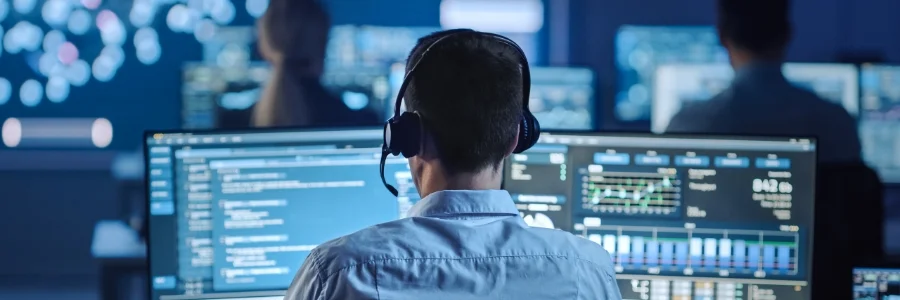
Business continuity is a complex aspect of modern business that requires more than just backup systems and recovery plans. Cybersecurity monitoring has become just as vital for maintaining operational stability and responding effectively to security incidents before they escalate into full disruptions.
Understanding the importance of 24/7 cybersecurity monitoring starts with recognizing how deeply digital systems are embedded in daily operations.
What is the connection between monitoring and business continuity?
Business continuity is a business’s ability to regain and maintain critical business processes during and after a disruption. Traditionally, this focused on physical disasters, system outages, or supply chain interruptions. Today, cyberthreats are among the most frequent and disruptive risks to business operations.
Cybersecurity monitoring supports business continuity by providing constant oversight of an organization’s network infrastructure, endpoint devices, cloud resources, and user activities. This visibility allows security teams to detect threats early, respond quickly, and reduce the overall business impact of security incidents.
Without continuous monitoring, attacks often go unnoticed until systems are compromised, data breaches occur, or services are disrupted. At that point, recovery becomes more expensive and complex.
Why modern cyberthreats demand constant monitoring
Cyberthreats no longer follow predictable schedules or patterns. Attackers exploit automated tools, compromised accounts, and emerging vulnerabilities around the clock. Internal and external threats can originate from phishing emails, malicious activity on mobile devices, or unauthorized access to cloud environments.
Hackers may also probe systems quietly, analyze network traffic, and move laterally across an organization’s networks before triggering a noticeable event. Without real-time threat detection, these activities blend into normal network activity and remain undetected.
Cybersecurity monitoring tools analyze data continuously to identify anomalies, known attack patterns, and suspicious behavior. This allows organizations to respond while threats are still manageable rather than reacting after damage has occurred.
The limits of traditional security approaches
While traditional security tools like firewalls and antivirus software are still necessary, they’re no longer enough to keep you safe. They mainly catch known threats, which means they can miss new or altered attacks. One-off security checks, like vulnerability scans, are also limited because they only offer a snapshot in time. In between these checks, your systems can change, new threats can appear, and your defenses become outdated.
Cybersecurity monitoring addresses these gaps by observing networks, endpoint devices, and cloud resources continuously. It complements existing security tools and strengthens the overall security posture by adding context and correlation across systems.
Key components of 24/7 cybersecurity monitoring
Effective 24/7 cybersecurity monitoring requires multiple layers working together to ensure comprehensive protection. Here are the key components:
- Security monitoring: Collects and analyzes data from the IT environment, including network traffic, endpoints, cloud systems, and user activities.
- Intrusion detection and prevention: Identifies suspicious network activity and blocks malicious behavior.
- Endpoint detection: Monitors activity on devices like laptops, servers, and mobile devices — all common entry points for attackers.
- Threat intelligence: Provides insights into emerging trends, known attack patterns, and active threats across industries.
- Behavioral analysis: Detects unusual user behavior to identify compromised accounts or insider threats.
What are the benefits of cybersecurity monitoring?
With strong cybersecurity monitoring from a reliable provider, your business can:
Mitigate the impact of data breaches
Data breaches represent one of the most damaging outcomes of insufficient security monitoring. They often result in hefty regulatory penalties, reputational harm, and long-term loss of customer trust. Cybersecurity monitoring tools help identify unauthorized access, abnormal data transfers, and malicious activity before sensitive business data is exposed. Early detection limits data exposure and makes remediation easier.
Keep insider threats at bay
While external threats receive much of the attention, insider threats remain a significant risk to business continuity. Monitoring user activities, endpoint devices, and network behavior helps identify unusual actions that may indicate insider threats. These include unauthorized access attempts, abnormal file movement, or changes to security policies. By observing user behavior, companies can detect issues early and address them before they are exposed.
Protect complex cloud environments and hybrid infrastructure
As organizations adopt cloud computing and hybrid environments, visibility becomes more complex. Cloud monitoring tools track activity across cloud environments, including access to cloud resources, configuration changes, and network connections. This visibility helps identify vulnerabilities and detect threats that target cloud native workloads.
Improve incident response and decision-making
Effective incident response depends on accurate, timely information. Cybersecurity monitoring provides the data security teams need to understand the scope and severity of security incidents.
Security information and event management systems correlate alerts from multiple data sources. By doing so, they reduce noise and highlighting which events are most likely to be actual threats. This allows security teams to focus on pursuing and mitigating active threats rather than chasing false positives.Clear insight into attack behavior also supports better decision-making during incidents. As a result, organizations contain damage and restore normal operations more quickly.
Maintain regulatory compliance and industry standards
Many regulations and industry standards require continuous security monitoring, logging, and incident response capabilities. Cybersecurity monitoring supports compliance by providing evidence of oversight, detection, and response activities.
Certain security data patterns help demonstrate adherence to regulatory requirements and internal security policies, reducing audit risk. They also support consistent governance across the organization. For regulated industries, continuous monitoring is a requirement tied directly to business continuity management.
Strengthen security posture
Cybersecurity monitoring is not a one-time deployment. It’s a continuous process that evolves alongside the organization. As systems change, cybersecurity monitoring tools can adapt to the slightest shifts in user activity, new technologies, and threat intelligence updates. Over time, the tools can fully learn the company’s security environment to increase detection accuracy, reduce response times, and support better decision-making. These improvements directly support long-term business continuity goals.
Turning monitoring into a strategic advantage
When implemented thoughtfully, cybersecurity monitoring becomes more than a defensive measure. It provides insight into system behavior, risk trends, and operational weaknesses that inform broader security strategy.
Integrating monitoring into business continuity planning enables organizations to be more proactive. This shift reduces risk, protects business data, and supports sustained operations in the face of evolving cyberthreats. If your organization is evaluating how cybersecurity monitoring fits into its business continuity strategy, Superior Technology Solutions can help. Our team delivers around-the-clock security monitoring designed to identify threats early, support effective incident response, and protect critical systems. Contact us today.